Welcome to EBA Talks
We’re excited to have you join us for EBA Talks, a day of inspiring conversations, practical insights, and industry connections. This page has everything you need to make the most of your experience.
What You’ll Find Here
Speaker Lineup & Bios
Learn more about our incredible speakers — their backgrounds, expertise, and what they’ll be sharing at EBA TalksAgenda for the Day
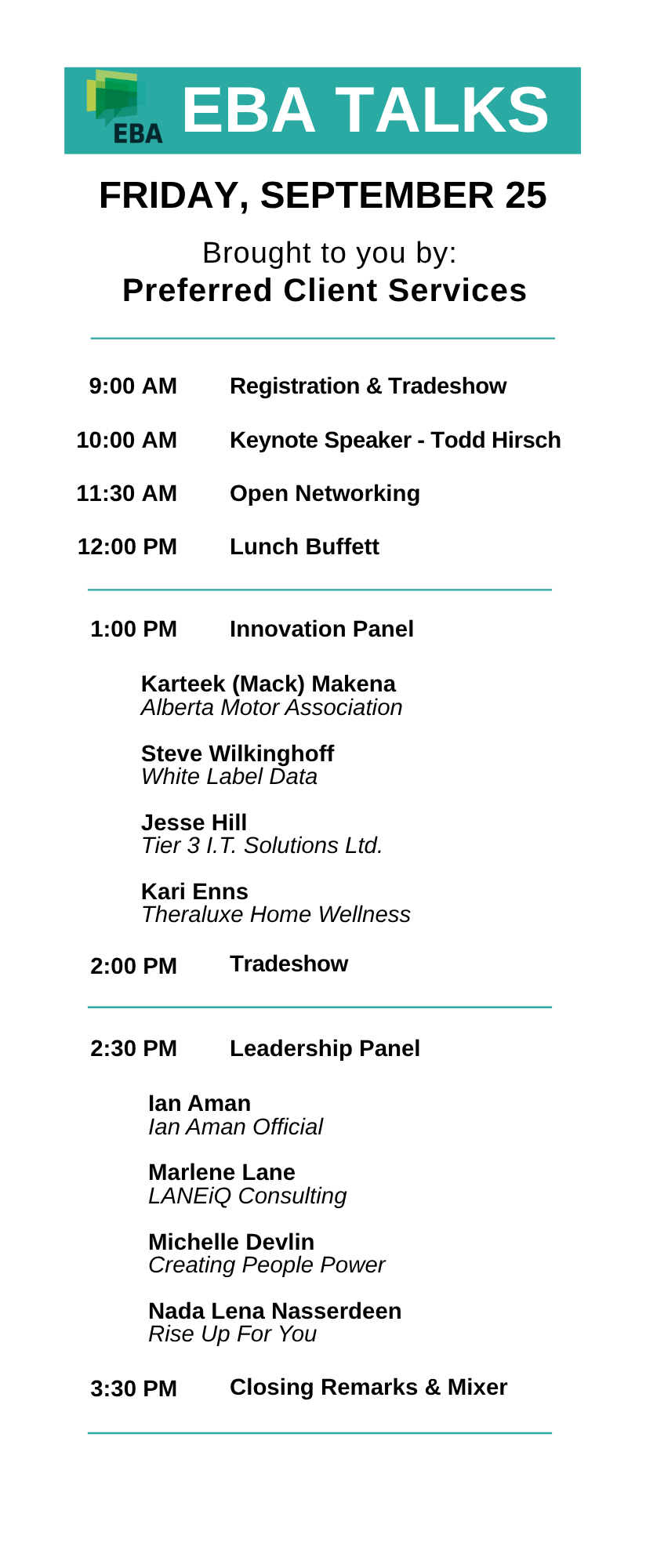
Review the full event schedule, so you can plan ahead and be sure not to miss the sessions most relevant to youOur Sponsors
Discover the organizations that make EBA Talks possible
Additional Resources
To make your experience even smoother, we’ve also included:
Networking Opportunities – Details on breaks, receptions, and how you can connect with fellow attendees
Downloadable Materials – Slides or resources provided by speakers
Contact Information – Quick access if you have questions before or during the event
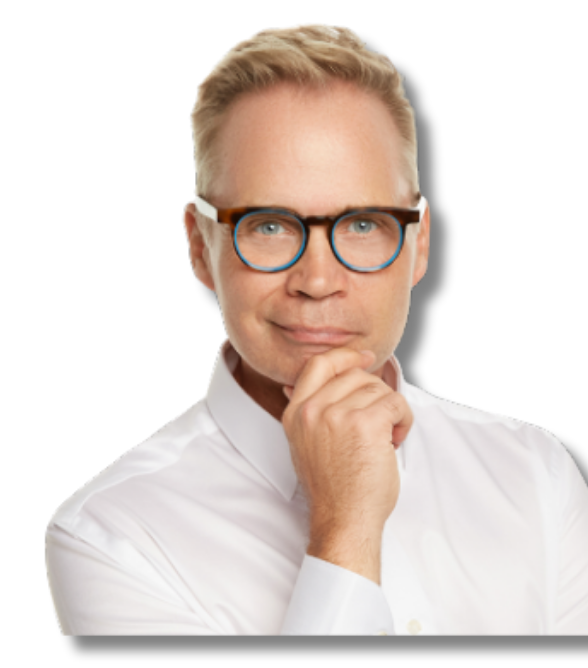
TODD HIRSCH
We’re excited to welcome one of Canada’s most respected economists and a leading voice on how organizations can navigate volatility, disruption, and economic uncertainty. After more than 25 years analyzing global trends, Todd has shifted the conversation from predicting the future to preparing for it — equipping leaders with the tools, traits, and strategic mindset needed to adapt in chaotic conditions.
As the keynote presenter for EBA Talks 2026, Todd will deliver Navigating the Economic Chaos, a timely and practical session designed for Alberta entrepreneurs facing rapid change, unpredictable markets, and emerging technological pressures. His work helps business owners understand the macro disruptors reshaping today’s economy, from geopolitics and extreme weather, to financial instability, technological acceleration and how we can respond with clarity and confidence.
Todd is known for his compelling storytelling, powerful imagery, and ability to translate complex economic trends into relatable insights leaders can act on immediately.
He is also a celebrated author whose books blend economic insight with human storytelling, providing encouragement and perspective for navigating change. Todd’s presentations have influenced executives, government leaders, and global organizations, earning praise for their clarity, energy, and lasting impact.
At EBA Talks 2026, Todd sets the stage for a full day focused on innovation readiness, leadership agility, and the future of business in Alberta.
INNOVATION PANEL:




Karteek (Mack) Makena
If you follow the news about AI, it can be difficult to know what to believe. It can do almost anything. Or it’s overhyped and doesn’t really work. What I’m seeing in practice gives me plenty of reason to be optimistic. I’ve seen solo business owners make immense productivity gains. I’ve seen large organizations achieve gains just as significant.
But the amount and type of effort required were very different. Understanding that difference can help you decide where your business should start.
When I talk about business size, I’m interested in how people share the work. A solo owner can use a personal AI assistant like ChatGPT or Copilot across the business: research, proposals, and follow-ups.
You hold the context, judge the results, and connect the work. Your freedom advantage is that you can apply a better approach immediately without coordinating the change across a team. Companies made up of independent contributors can also enjoy similar freedom and productivity gains.
In my own interactions, I’ve found the greatest skepticism about AI among small businesses with this kind of interdependent work. The challenge is turning individual productivity into business productivity.
steve wilkinghoff
For 800 years, a bell tower has stood in Pisa. It was meant to be a stunning seven-bell tower, to ring out over the church beside it. Instead, the bells had to be silenced after only a short time, because the structure couldn't bear the strain. We know it today as the Leaning Tower of Pisa.
But the lean itself isn't the failure. What failed was a chain of decisions.
After only the second floor, the tower began to tilt. This was an early, honest, still-fixable warning sign caused by unstable soil and a shallow foundation. The builders' response wasn't to stop and fix it. It was to keep building, floor after floor, hoping the problem would somehow resolve itself.
My talk argues that the exact same trap is waiting in AI and automation today: the pressure to build the impressive, headline-worthy thing while treating fundamentals such as data quality, process discipline, honest diagnosis, as something to be glossed over. And when early warning signs appear, the instinct is the same one the tower's builders had: keep going, hope it resolves itself, or paper over it with another tool.
I’ll give three practical lessons drawn from the Leaning Tower of Pisa on how to fix the actual cause rather than covering them over.
Jesse hill
Artificial intelligence is changing business faster than almost any technology that came before it. New tools promise greater efficiency, smarter decisions, better customer insights, and the ability to automate work that once consumed hours of employee time.
The opportunity is real. But are businesses ready for it?
At EBA Talks, Jesse Hill of Tier 3 I.T. Solutions will explore why the most important question leaders can ask about AI isn’t “Where can we use it?” It’s “Where are we trying to go?”
Using the evolution of aviation as a metaphor, Jesse will examine the gap between technological capability and organizational readiness. The Wright brothers proved that humans could fly—but turning that breakthrough into safe, dependable commercial aviation required an entire ecosystem of training, standards, infrastructure, procedures, and controls.
AI can help businesses do extraordinary things. The opportunity is to use it intentionally—to create better outcomes for employees, clients, businesses, and communities.
We’re ready to fly. Now let’s make sure we choose a destination worth going to.
Kari enns
What happens when you start a luxury sauna company with no money, no resources, and just enough confidence to think, “How hard could it be?”
You build it anyway.
Kari Enns takes you behind the scenes of Theraluxe Home Wellness and shares the real story of how a small Canadian sauna company grew into a globally recognized luxury wellness brand - and how technology has played a critical role along the way.
From AI and automation to marketing, systems, and the everyday tools that help a lean team do the work of a much larger organization, Kari will share real examples of how Theraluxe uses technology to work smarter, move faster, and maintain a competitive edge in 2026.
This talk challenges the assumption that growth requires more money, more people, and more resources. Instead, it explores how strategic thinking, resourcefulness, and smarter leverage can help entrepreneurs build something remarkable with what they already have.
You’ll leave with a fresh perspective on what’s possible, practical ideas you can take back to your own business, and maybe a little more confidence to finally go for the thing you’ve been thinking about.
LEADERSHIP PANEL:
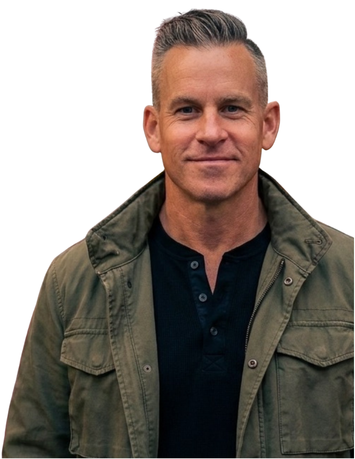
IAN AMAN
Your best people are often the closest to burning out. The high performers who never say no, who carry the hardest quarters, who answer at midnight, are the same ones quietly running on empty. And in an uncertain market, the instinct for all of us is the same: push harder, work more hours, grind through it.
In this talk, Ian Aman makes a counterintuitive case. What if the thing standing between your leaders and their next level is not more effort, but strategic disconnection: the deliberate act of stepping back to reassess and rebuild.
Ian spent 30 years as a corporate executive in insurance and banking, climbing through VP level roles while slowly burning out. His comeback did not come from working harder. It came from stepping back on purpose, rebuilding across the five domains that carry a leader, and returning sharper than he had ever been at his desk. He wrote about it in his book, Disappear For A Year, and now helps leaders and teams do it before burnout forces the issue.
This talk reframes disconnection as a leadership strategy rather than a retreat, and shows why the leaders who master it are building one of the most underrated competitive advantages in business today. You will leave with a simple, repeatable way to protect your capacity, sharpen your judgment, and lead through change without breaking the people your business depends on most, starting with yourself.
The most resilient leaders are not the ones who grind the hardest. They are the ones brave enough to step back, so they can come back stronger.

Marlene Lane
Today's workplace looks different from the one many leaders started in. Multiple generations now work side by side, each shaped by different experiences and bringing different expectations about work, flexibility, contribution and loyalty.
My presentation explores what this means for leadership and asks whether some of our long-held assumptions about how we lead have kept pace.
Leading a multigenerational workforce isn't about defining employees by generation or deciding which generation has it right. It's about recognizing that people value different things, communicate differently, and have different needs at different stages of their careers.
I look at how our ideas about contribution, flexibility and loyalty are shifting. Does commitment require being in the office at traditional hours? Can flexibility and accountability coexist? And when we talk about employee loyalty, are we considering the experience that earns it?
People don't just leave organizations. They leave experiences. They leave people.
Leaders shape those experiences through everyday choices: how we listen, communicate, recognize contribution, demonstrate trust, and respond to individual circumstances.
Keeping pace doesn't require a new program, a bigger budget, or an overnight overhaul. Sometimes it starts with questioning an assumption, having a different conversation, or trying one small change.

MICHELLE DEVLIN
What’s Your Change Vibe?
It’s 1971 and rock icon David Bowie released the song: Changes.
55 years later, people are still figuring out how to deal with CH-CH-Changes in our workplaces. Whether we are trying to keep up with AI or the latest technology or tariff, I wonder if we aren’t forgetting about our greatest asset - our people?
Research shows the pace of change today is faster than ever, and decisions are increasingly complex and visible, so understanding how change impacts our teams is critical. Two people can sit in the same meeting, hear the same announcement, and walk away with completely different reactions. Why? We experience change differently.
When working with clients, one of my favourite games is the Green Jelly Bean Game developed by Dr. Aaron Dinin of Duke University (Learning to Fail). Cue Ambiguity. With few rules (only one) and no instruction, participants are foisted into an activity of uncertainty.
This begs the question, what is needed to lead people through change? I believe there are 3 simple strategies that create a psychologically safe space to embrace change and it starts with knowing our teams “Change Vibe.”
Recognizing that people experience change differently and understanding what our team members need to move through change is truly what makes change initiatives successful. I challenge participants to consider their “Change Vibe” and offer strategies and key questions to consider when it comes to supporting others through change.

NADA LENA NASSERDEEN
Every one of us has watched someone brilliant fail to hold a room. The technical skill was never the problem. It rarely is.
The skills we call soft are the ones that decide whether a team performs or quietly falls apart. Whether the hard conversation happens or gets avoided for another six months. Whether your best people stay. They are not the finishing touch on a career. They are the foundation everything else sits on, and almost nobody is formally trained in them.
In this session, Nada Lena Nasserdeen takes the four that matter most and makes them practical: Self-Confidence, Emotional Intelligence, Transformational Leadership, and Influential Communication. These are the four pillars of the RISE Power Up Method, her registered framework now used inside organizations ranging from Fortune 5 companies to local nonprofits across North America and overseas.
Language for the conversations you have been putting off. A way to read the emotional temperature of your team and respond instead of react. Tools that treat confidence as a daily practice rather than a feeling you wait around for. And a clearer sense of the leader you are becoming, along with what is currently in the way.
Nada Lena Nasserdeen is Founder and CEO of Rise Up For You, a two time TEDx speaker, 2x bestselling author, and host of the Rise Up For You podcast. She has built her career proving that the human skills are the hard skills, and that they can absolutely be taught.

FEEDBACK SURVEY
We’d love your feedback on this year’s EBA Talks. Your input helps us make each event even better.
Scan the QR code or click here to complete the quick survey.
Share your feedback to help us strengthen future programming!